Sacramental Life
The Holy Mass is described as the ‘source and summit’ of our Christian life because the Eucharist contains the entire spiritual good of the Church— Jesus Christ Himself. Catholics are called to attend the celebration of Sunday Mass and on special holy days during the year. Weekday attendance is warmly invited.
See our home page for mass times and locations.
Sacraments of Christian Initiation
Baptism is an outward, visible sign instituted by Christ that imparts inward, spiritual grace. It is the gateway to the Christian life, washing away Original Sin and, in the case of those who have attained the age of reason, all personal sins. Through Baptism, a person is welcomed into the Catholic Church, becomes a member of the Body of Christ, and begins a new life in Christ. In the Catholic Church, Baptism is often celebrated during infancy, but it can be received at any stage of life. Adults who wish to become Catholic are invited to undertake a period of formation through the Rite of Christian Initiation of Adults (RCIA), now commonly referred to as the Order of Christian Initiation of Adults (OCIA).
Confirmation fulfils Jesus’ promise to his followers that He would send them the gift of the Holy Spirit who would help them to live as he had taught them and to pass on his message to all the nations. The bishop lays his hands on the baptised person and prays that the Holy Spirit will fill the person with spiritual gifts. Then, using holy oil, the bishop makes a cross on the person’s forehead.
Reconciliation (formerly known as Confession or Penance) is a healing ritual where a person confesses their sins to a priest, expresses genuine contrition, and receives God's absolution and forgiveness. It is designed to restore a person's relationship with God and the Church.
A confirmed Catholic can take part in Reconciliation at any time, however, children being prepared for the sacrament will often be received as a group before proceeding to individual reconciliation with a priest.
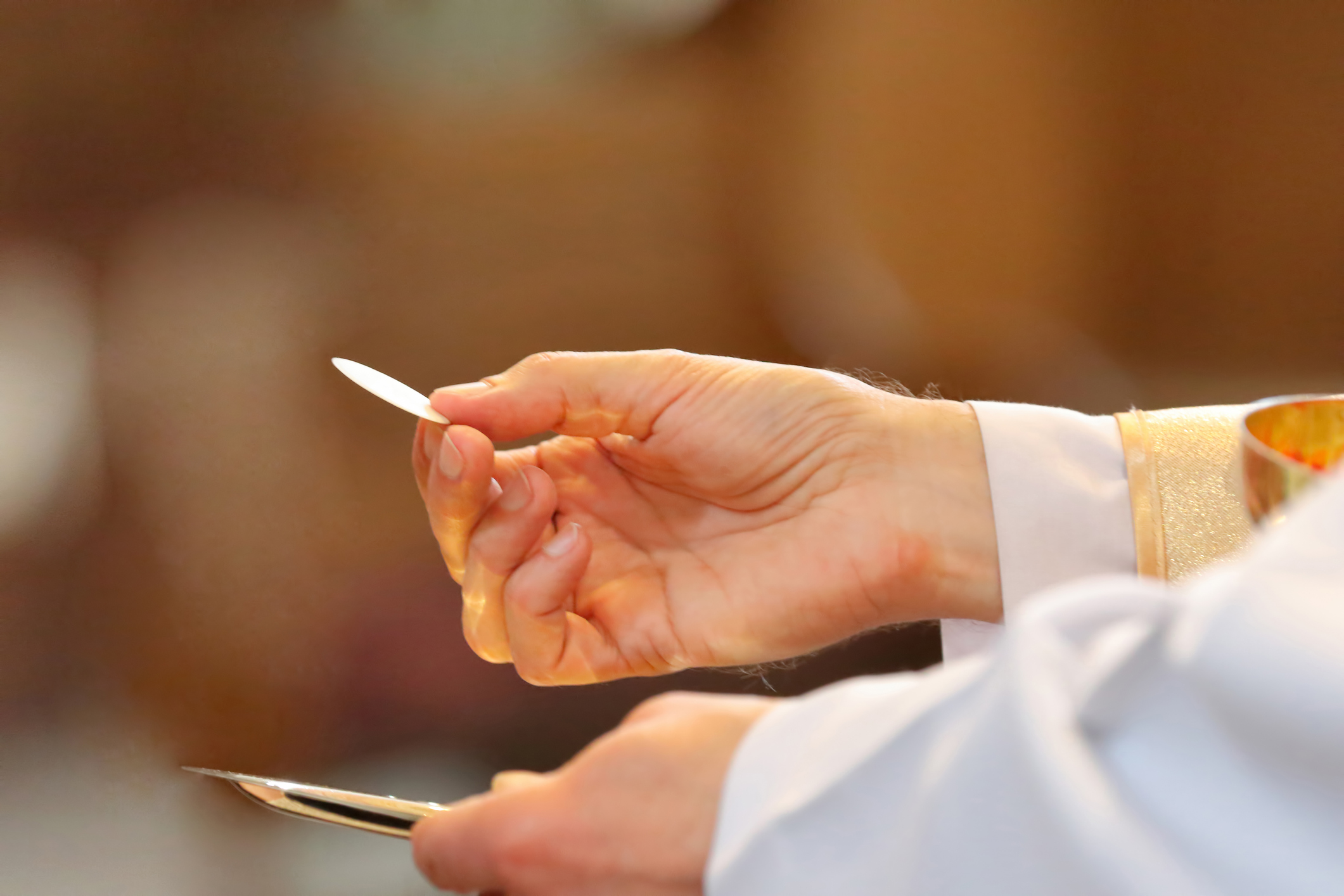
First Holy Communion is a significant sacrament in the Catholic Church, marking a person’s first reception of the Eucharist, the Body and Blood of Jesus Christ under the appearance of bread, and also wine if an adult. It signifies the individual’s full initiation into the Catholic faith and their deepening relationship with Jesus Christ. The relationship strengthens with every Mass that is attended where the Eucharist is celebrated.
Candidates in the RCIA program will often be baptised, confirmed, absolved and receive Holy Communion in one ceremony.
Sacraments at the Service of Communion and Mission
Matrimony (Marriage) in the Catholic tradition is a sacred, covenant between a man and a woman that establishes an exclusive lifelong bond. It is viewed not merely as a legal or social contract, but as a visible sign that confers God's grace and mirrors the unconditional love of Christ.
Marriage preparation courses are encouraged, and we have a variety of churches available from small and rural at St Dympna's Church Dunoon, an intimate chapel St Mary's, a medium-sized Our Lady Help of Christians South Lismore Parish to the magnificent St Carthage’s Cathedral. Please contact the Parish Office for more information.
Holy Orders is the Sacrament through which men are ordained to serve the Church as bishops, priests, or deacons. Priests may serve as diocesan priests, who minister within a diocese, or as religious priests, who belong to a religious institute and live according to its charism and spirituality. Both diocesan and religious priests receive the Sacrament of Holy Orders and serve the People of God through preaching, pastoral ministry, and the celebration of the sacraments.
Consecrated Life is a vocation in which men and women dedicate their lives to God through vows or other sacred bonds, following a particular charism and spirituality. It is commonly lived in religious institutes as religious brothers, sisters, or nuns. Examples include the Marist Brothers, Presentation Sisters, Josephite Sisters, and Carmelite Missionaries. Contemplative nuns, such as the Carmelite nuns, dedicate their lives especially to prayer and contemplation.
Sacraments of Healing
Anointing of the Sick is a sacred ritual in which a priest or minister anoints a person who is seriously ill, injured, or elderly with blessed oil. Often continuing Christ's healing ministry, it provides spiritual strength and comfort. Its primary purpose is not to restore physical health but to give a renewed share in spiritual life. If a person is at end-of-life, a priest can administer last rites, which comprises prayers for the dying and a commendation before death and absolution of sins through anointing. Please call our 24/7 number 6626 0200 if someone you know is in urgent need of this sacrament before death.
Of course, the grace of God can present itself at any time, so if a person has not been received into the faith but is in grave health and expresses genuine desire to receive the Lord as a Catholic, a priest will do all he can to make this happen.
Reconciliation (formerly known as penance or confession) is the sign of Christs’ willingness to heal us. This healing is also received in the initiation sacraments but can take part at any time.
Funerals (Rite of Committal)
In addition to these sacraments, we offer the following forms of funeral rites.
Funeral Mass (Requiem Mass): The most common option, which includes the Liturgy of the Word, hymns, and the Liturgy of the Eucharist (Holy Communion).
Funeral Liturgy Outside Mass: A service that includes scripture readings and prayers but omits the Eucharist. This is often chosen when the majority of attendees are not practicing Catholics or if a priest is unavailable.
Graveside Service Only: A simplified variation where the only ceremony is the committal prayer at the burial site.
Please ensure you have contacted your preferred Funeral Director before contacting the Parish Office.
The same consecrated spaces that conduct weddings can also be used for funerals.