Our Vision
To act justly, love tenderly and walk humbly with our God as we grow together in faith, hope and charity.
Our Mission
We enact our mission by:
-
Living our lives as Christ calls us through God’s Word, the Sacraments, Evangelisation, Parish Ministries and Outreach Services to the broader community.
-
Being a welcoming community, seeking to engage and support each other through our spiritual, pastoral and faith-based growth.
-
Encouraging parishioners to be actively engaged in the life of the parish, participation in ministries and faith formation experiences and outreach.
-
Supporting and encouraging our Youth through our witness to Christ in our community.
-
Responding positively to the challenges to remain a strong faith community prepared to be open and accepting of all and especially the marginalised
What do we believe?
The universal Church and its beliefs are articulated in the Apostles’ Creed:
I believe in God, the Father almighty,
Creator of heaven and earth,
and in Jesus Christ, his only Son, our Lord,
who was conceived by the Holy Spirit,
born of the Virgin Mary,
suffered under Pontius Pilate,
was crucified, died and was buried;
he descended to the dead;
on the third day he rose again;
he ascended into heaven,
and is seated at the right hand of God the Father almighty;
from there he will come to judge the living and the dead.
I believe in the Holy Spirit,
the holy catholic Church,
the communion of saints,
the forgiveness of sins,
the resurrection of the body,
and life everlasting.
Amen.
Community Profile - 2021 Census Data
St Carthage’s Cathedral Parish is one of the largest Catholic communities in the Diocese of Lismore, serving a population area of 39,071 people, of whom 6,932 identified as Catholic, representing 17.7% of the local population. The median age of Catholics in the parish is 48 years, reflecting a mature and established community.
The parish community is characterised by strong family and household connections, with 2,854 Catholic families residing within parish boundaries. At the same time, 843 Catholics live alone, highlighting the importance of pastoral outreach, social connection and support for older parishioners and those experiencing isolation.
The Catholic population is becoming older over time. Between 2016 and 2021, the proportion of Catholics aged 65 years and over increased from 19.8% to 24.3%, while the proportion of Catholics aged 0 to 14 years declined from 18.3% to 15.5%. During the same period, the Catholic population decreased from 7,766 to 6,932 people.
The parish includes a culturally diverse community. 630 Catholics were born overseas, while only 34 Catholics reported limited English proficiency, indicating generally strong integration within the local community.
Educational attainment continues to grow, with the proportion of Catholics holding a university degree increasing from 16.3% to 18.9% between 2016 and 2021. Catholic school participation is also strong, with 69.9% of Catholic students attending Catholic schools in 2021, up from 62.1% in 2016.
The parish demonstrates relative housing stability, with 76.5% of Catholic households owning or purchasing their home, and 2,477 Catholics having changed address since 2016. Additionally, 583 Catholics reported needing assistance with core activities, reflecting a significant pastoral opportunity in aged care, disability support and community accompaniment.
Parish Prayer
Heavenly Father
and God of Mercy
You have given us
St. Carthage to proclaim
the riches of Christ.
By the help of his prayers
may our Cathedral Parish
grow in knowledge of You,
be eager to do good,
and learn to walk
before You by living
the truth of the Gospel.
May we walk in the
footsteps of the Good Shepherd,
keeping before us
the example of St Carthage.
Educate us to a maturity
not measured by nature,
but by the fullness of Christ.
With the guidance
of the Holy Spirit,
we offer this prayer
through Christ Our Lord.
Amen (Alleluia)
St Carthage died 637 AD
Feast Day May 14th
A Parish Across City and Hinterland
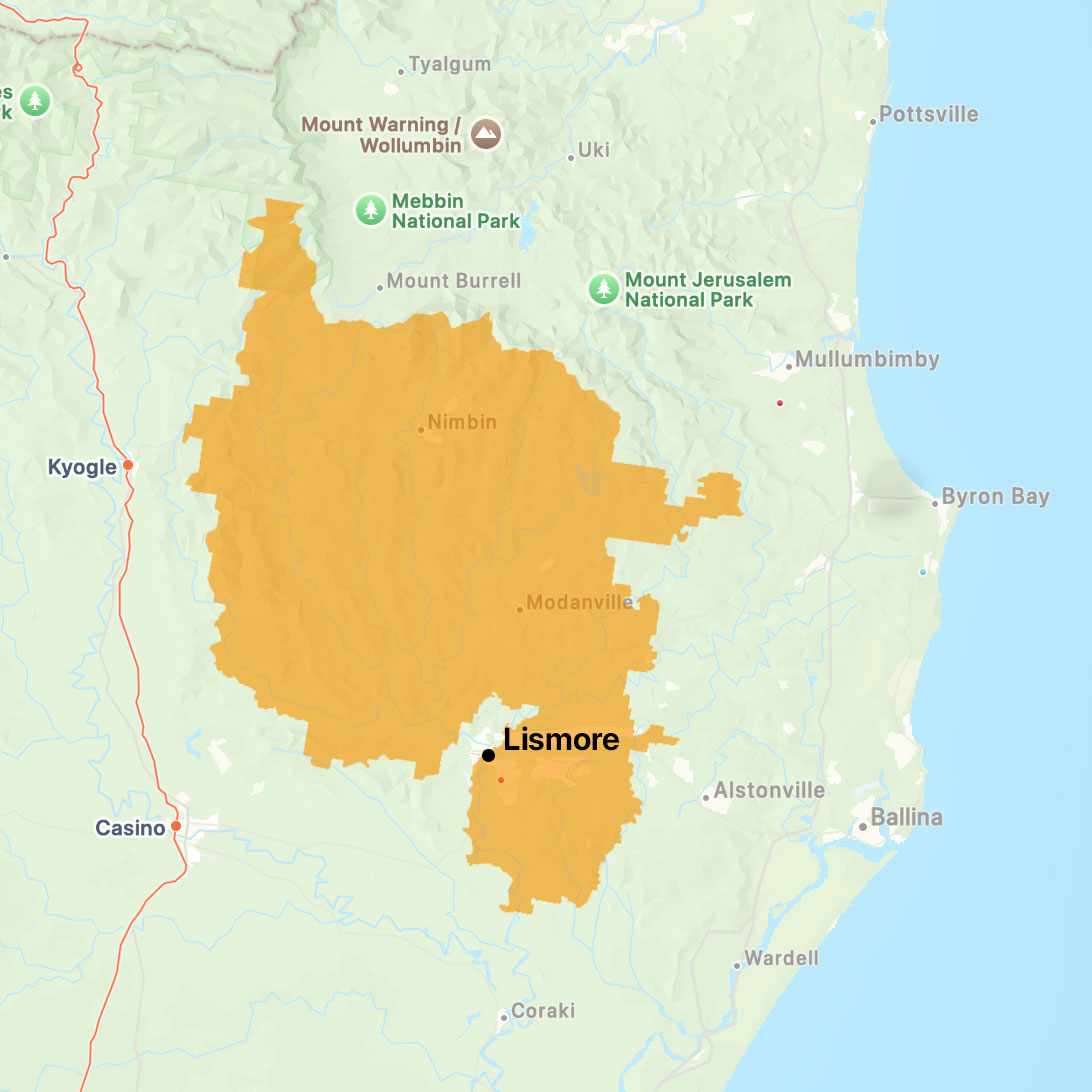
St Carthage’s Cathedral Parish is centred in the regional city of Lismore and serves a diverse area extending beyond the city to the communities of Goonellabah, Dunoon, Goolmangar and Terania.
Geographically, the parish is centred on Lismore, the principal administrative and commercial hub of the Northern Rivers region, situated on the floodplain of the Wilsons River. From this urban centre, the parish extends eastward to Goonellabah, a major residential suburb located on elevated ridgelands overlooking the city, and north-westward through the rural communities of Goolmangar and Dunoon, which are characterised by farming landscapes, rolling hills and village settlements. Beyond Dunoon, the parish also reaches into the Terania district, a sparsely populated rainforest and hinterland area bordering the Nightcap Range.
This creates a parish with a diverse physical setting: from a regional city and suburban neighbourhoods to farming districts, villages, rainforest hinterland and mountain foothills. The result is a geographically dispersed Catholic community whose identity is shaped by both the urban life of Lismore and the rural character of the wider Northern Rivers landscape.
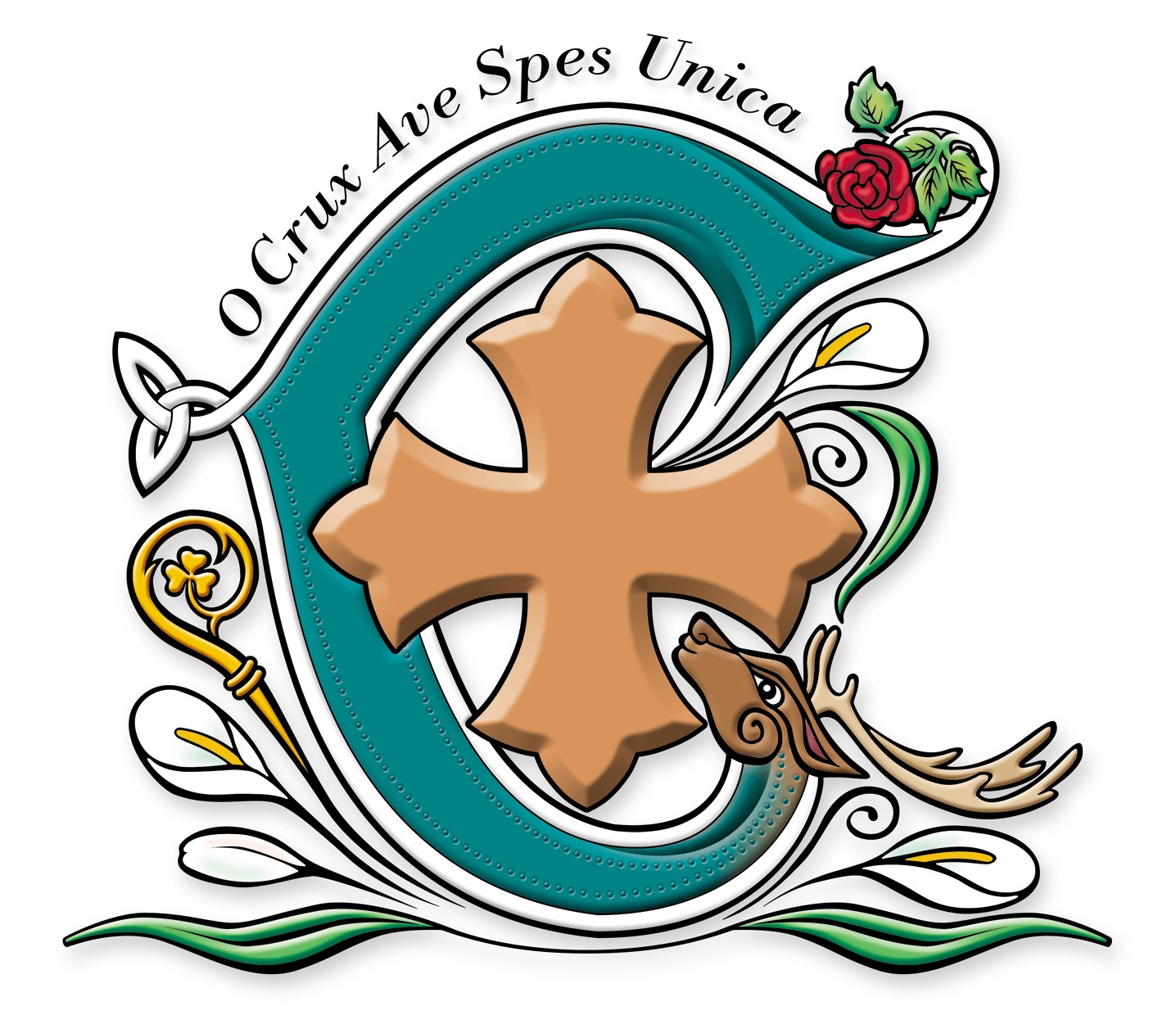
St Carthage’s Cathedral Parish Crest
‘O Crux Ave Spes Unica’ - ‘O Cross, Hail, Our Only Hope’ This is the motto on the Great Seal of the Diocese of Lismore which was introduced by Bishop Carroll who was bishop from 1910-1949.
A Red Rose – Roses are found on the Lismore NSW City Crest.
Centre Cross – A square and bevelled terracotta cross in the patonce style. It is the characteristic cross of the Cathedral and is on all the Cathedral’s prominent exterior points.
Stag Head – The Stag’s Head is from the Doyle Family Crest. Jeremiah Doyle [1849 – 1909] built St Carthage’s Cathedral. He was the first Parish Priest in Lismore from 1878, and the first Bishop of Lismore from 1887 until his death in 1909.
Celtic “C” – The Celtic style “C” is inspired by the eighth century Book of Kells. It is representative of St Carthage, also called Carthach or Mochuda. St Carthage was a seventh century monk, scholar and bishop who died in 637AD. He founded the great monastery and school of Lismore in County Waterford in the south of Ireland. We can still read his Rule. Alfred the Great studied at Lismore.
Atrium Lily – The lily is the symbol of religious faithfulness and purity for which St Carthage was famous.
Crozier – Lismore is an episcopal city. This crozier belonged to Bishop Patrick Farrelly who was the bishop from 1949 – 1979. It indicates that Lismore is the seat of the bishop whose diocese covers the north and mid-north coast of NSW.
Celtic knot – The Celtic 3 fold knot represents the Holy Trinity; the Father, the Son and the Holy Spirit. On the rock of this faith St Carthage founded his life.
Safeguarding
The emotional, physical, and spiritual safety, well-being, and dignity of all within our parish and the broader diocese is an integral part of the teachings and values of the Catholic Church.